The Queensland WHS Legislation and the Managing the Risk of Psychosocial Hazards at Work Code of Practice require PCBUs (persons conducting a business or undertaking) to apply the hierarchy of controls specifically for psychosocial risks.
The use of the hierarchy of controls, means that higher-order controls (such as job design changes) must be considered and prioritised over lower-order measures (such as Employee Assistance Programs or educational programs) for managing psychosocial hazards.
The use of the hierarchy of controls is well established and has become second nature when dealing with more traditional ‘safety’ risks – we can likely all remember examples discussed by the WHSQ in their guidance material about applying the hierarchy when managing work at height risks – but it is notably less straightforward when considering complex psychosocial risks including workplace stress, bullying, and harassment. This is because of the very nature of psychosocial hazards, their inter-related causal factors, and the way these impact each worker differently.
Applying the established framework of the hierarchy of controls to the management of psychosocial risks requires thinking outside the established traditional interpretation. The ‘elimination’ option still correlates to eliminating or removing the psychosocial hazard from the workplace, but how do you apply an engineering control to a psychosocial hazard?
Looking interstate there are no real insights that can be gleaned. Primarily this is because few states as yet require this approach. New South Wales, Western Australia and Tasmania do not mandate the use the hierarchy of controls (even though it’s encouraged as best practice) and, as at the time of publication, Victoria does not yet have specific psychosocial risk regulations in place (they are expected at the end of the year).
Perhaps a useful approach comes from across the ditch, from the New Zealand regulator, who offers the following guidance to assist with understanding and interpreting the hierarchy of controls for psychosocial risks:
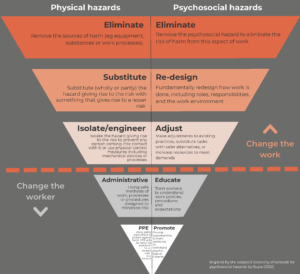
It should also be noted that researchers from La Trobe University have developed a new “Work Systems Hierarchy of Controls” (WS-HOC) to focus the redesign of “work systems in which people are key”, recognising that many psychosocial issues stem from how work is organised, rather than individual worker issues. By emphasising the redesign of work systems, this new approach aims to tackle the complex causes of psychosocial risks more effectively.
Managing psychosocial risks may prove to be challenging and problematic initially when compared to physical risks to health and safety, however, the application of the same risk management approach and utilisation of the hierarchy of controls is the best starting point. As we get more familiar with the management of psychosocial risks, this approach and a focus on the way in which work is done should start to see a reduction in the impact that these risks currently pose to worker health and wellbeing.
Please contact us for more information or assistance.